
Hanging pot storage is one of the most practical solutions for a busy kitchen. It gets bulky cookware out of your cabinets and puts it right where you need it. But there’s a common problem, especially in smaller homes or apartments. Many traditional pot racks are heavy, bulky, and cast large, dark shadows. They can instantly make a kitchen feel smaller, darker, and more crowded. If you have low ceilings or limited natural light, a standard pot rack can feel less like a storage solution and more like a permanent storm cloud over your countertops.
For years, I’ve helped people organize their kitchens to be more functional and beautiful. My name is Edom Clark, and I’ve spent the last five years exploring and writing about kitchen storage solutions that work for real-life homes. My passion is finding clever ways to solve common problems, especially in spaces that feel challenging. I believe a well-organized kitchen isn’t about having the most space, but about making the most of the space you have. It’s about creating flow, ease, and a sense of openness, which is why managing light is just as important as managing clutter.
I’ve seen firsthand how the wrong storage can disrupt a room’s entire feel. A client of mine with a lovely but compact apartment kitchen once installed a large, wrought-iron pot rack. The result? Her main prep area was constantly in shadow, and the rack completely blocked the view across the room, making the space feel cut in half. We replaced it with a much simpler system, and the change was immediate. The light returned, the room felt bigger, and she fell in love with her kitchen again. It’s experiences like these that have taught me the nuances of choosing storage that works with your space, not against it.
Why Traditional Pot Racks Often Fail in Modern Kitchens
The classic, large-footprint pot rack—often a big oval or rectangular grid—was designed for spacious country kitchens with high ceilings and ample light. In that context, they work beautifully. But when you place that same design into a kitchen with standard 8-foot ceilings or a smaller footprint, several problems emerge.
- Visual Bulk: Heavy materials like iron or thick wood create a massive visual block. Your eyes stop at the rack instead of traveling through the space, which makes the room feel smaller and the ceiling feel lower.
- Shadow Casting: A large, solid rack placed under a central light fixture acts like an umbrella, casting a wide shadow directly onto your most important workspaces—the island or countertops. This forces you to rely on under-cabinet lighting and can make cooking feel like you’re in a cave.
- Obstructed Sightlines: In open-concept living areas, a bulky pot rack can create an unnecessary visual barrier between the kitchen and the dining or living room. This disrupts the open, airy feel that makes these layouts so popular.
Let’s break it down: the issue isn’t hanging your pots. The issue is hanging them on a structure that wasn’t designed for light preservation or the scale of a modern, compact home.
The Core Principles of Light-Friendly Pot Storage
To successfully hang pots without sacrificing light and space, you need to shift your thinking. Instead of focusing on the rack itself, focus on how it interacts with the light and volume of your room. Here are the three principles I always follow.
Minimize Visual Mass
Visual mass refers to how “heavy” an object appears to the eye. For a pot rack, this is key. You want a design that is strong enough to hold your cookware but seems to disappear as much as possible. Look for systems built with thin, skeletal frames. Materials like brushed steel, thin wire grids, or single bars have very low visual mass. They define a storage space without filling it. Transparent materials like acrylic or glass are even better, as they allow light to pass through them almost completely unobstructed. The goal is to create a “less is more” effect, where the pots themselves are the main visual element, not the rack holding them.
Strategic Placement is Everything
Where you hang your pot rack is just as important as what you hang. The worst possible placement is directly between your main overhead light source and your primary prep counter. This is a recipe for shadows. Instead, consider these locations:
- Over an Island, Offset from the Light: If you hang a rack over an island, try to position it so the main ceiling light isn’t directly above it. This allows light to come in from the side, minimizing direct downward shadows.
- Along the Perimeter of the Room: Placing a linear rack near a wall or along the edge of the ceiling keeps the central airspace open. This preserves sightlines and prevents the room from feeling crowded.
- In Front of a Window (With Caution): A very minimalist, open-wire rack can be placed in front of a window, but only if it’s a very open design. This allows you to use otherwise dead space without significantly blocking your natural light source.
Understand Shadow Management
Every object casts a shadow, but you can control the size and harshness of that shadow. A wide, grid-style rack will cast a diffuse, net-like shadow over a large area. A simple, linear bar rack, on the other hand, will cast a single, thin shadow. When planning your installation, think about the “shadow footprint.” A linear rack installed parallel to your countertop will cast a shadow line that might fall harmlessly on your backsplash. The same rack installed perpendicularly could cast a dark line right across your cutting board. The trick is to orient the rack to control where its minimal shadow will fall.
Top Hanging Pot Storage Systems That Preserve Light
Once you understand the principles, you can start looking at specific systems. These are my go-to solutions for clients who need storage but are worried about blocking light.
The Airy Wire-Grid System
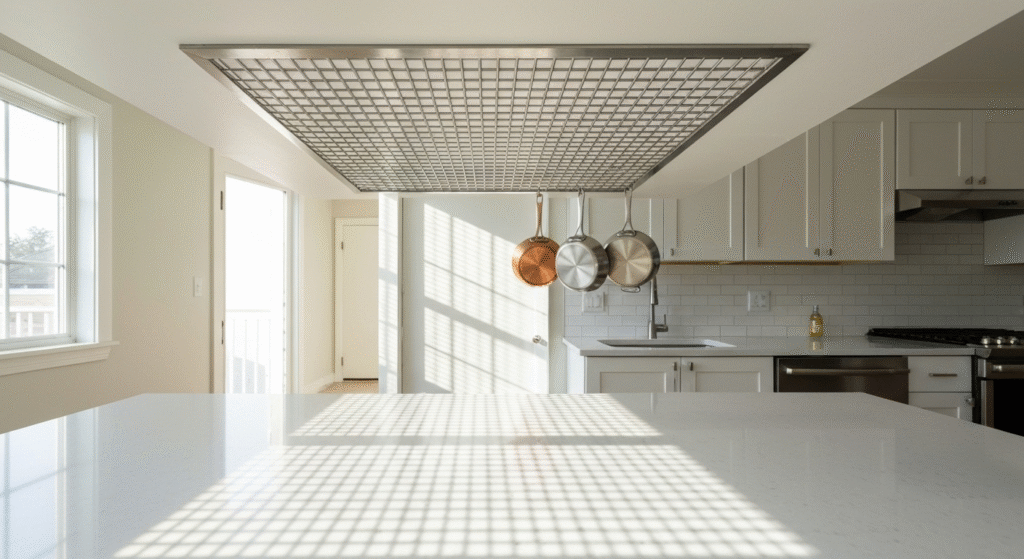
This is a fantastic modern alternative to the classic bulky rack. Imagine a simple, open grid made of thin but strong wire, often stainless steel. It provides the same versatile hanging surface as a traditional rack but with a fraction of the visual weight. The open squares allow light from above to pass through easily, and the slim profile keeps it from dominating the room.
Last year, I worked with a client in a narrow galley kitchen. There was no room for a big rack, and the single overhead light needed to illuminate the whole corridor. We installed a slim, rectangular wire-grid system mounted flush against the ceiling. Because it was so open, light passed right through it, and the pots looked like they were floating. It added a ton of storage without making the narrow space feel even tighter.
- Pros: Highly flexible for hook placement, minimalist aesthetic, allows excellent light pass-through.
- Cons: Can still look cluttered if you hang too many items on it.
The Sleek Linear Bar Rack
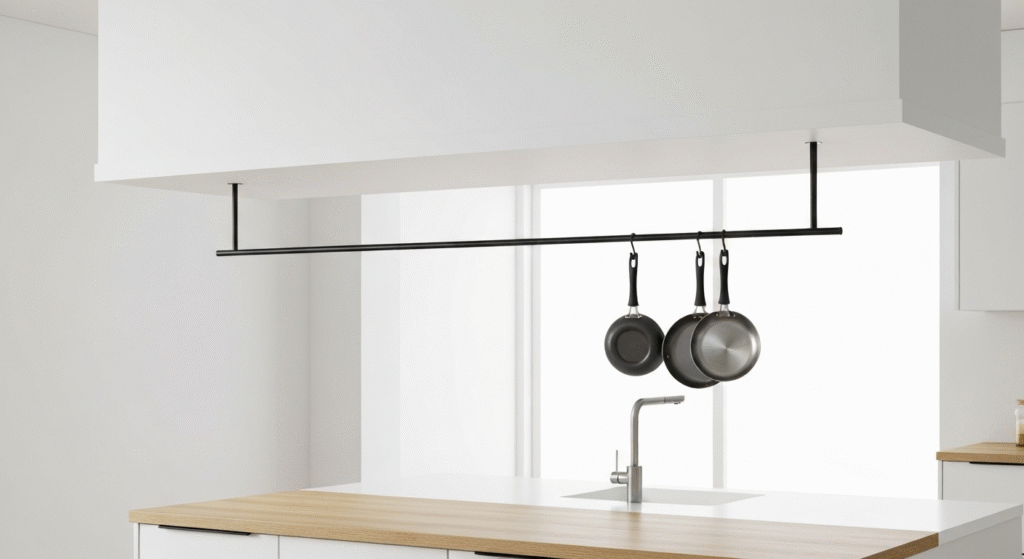
This is the champion of minimalist pot storage. A linear bar rack is simply a single, sturdy bar (or sometimes a double or triple bar) mounted to the ceiling. Its visual footprint is incredibly small, casting only a thin line of shadow. These are perfect for positioning along a wall, over the end of an island, or in any space where you want to keep the center of the room completely open. They force you to be intentional about what you hang, which can be a great way to avoid clutter.
- Pros: Extremely low profile, directs storage into a clean line, ideal for very small spaces or low ceilings.
- Cons: Limited storage capacity compared to a grid.
The “Invisible” Glass or Acrylic Shelf Rack
For maximum light preservation, nothing beats a suspended shelf made of tempered glass or clear acrylic. These systems combine hanging storage (hooks can often be attached to the frame) with a shelf for items you can’t hang, like lids or colanders. Because the main surface is transparent, it allows almost 100% of the light from your ceiling fixture to pass through. It creates a high-end, architectural look while being incredibly functional.
- Pros: Unmatched light pass-through, provides both hanging and shelf storage, looks modern and clean.
- Cons:** Shows dust and fingerprints easily, can be more expensive, and requires a very secure installation due to the weight.
Wall-Mounted Rails and Pegboards
Don’t forget that you don’t have to hang things from the ceiling. Using vertical wall space is an excellent way to get pots and pans out of drawers without interfering with overhead light at all. A simple rail system with S-hooks or a full pegboard offers incredible flexibility. You can mount them over a countertop, on a backsplash, or on any free stretch of wall. This approach keeps your ceiling clear and your sightlines completely open.
- Pros: Zero impact on overhead lighting, highly customizable, uses otherwise empty wall space.
- Cons: Requires available wall space, may not be an option in kitchens with extensive cabinetry or windows.
Comparison: Wire-Grid vs. Linear Bar for a Low-Ceiling Apartment
Choosing between the two most popular light-friendly options often comes down to the specifics of your space. A client I recently advised was struggling with this exact choice for their apartment kitchen, which had 8-foot ceilings and only one window. Here’s a breakdown of how we compared the wire-grid and linear bar options for them.
| Feature | Wire-Grid System | Linear Bar Rack |
| Light Obstruction | Low. The open grid allows most light to pass through but casts a diffuse, net-like shadow. | Very Low. The single bar has a minimal profile and casts only a single, thin shadow. |
| Storage Capacity | High. The large surface area allows you to hang many pots, pans, and utensils. | Moderate. Limited to the length of the bar; best for an essential set of daily-use pans. |
| Visual Footprint | Small to Medium. While airy, it still occupies a significant area of ceiling space. | Very Small. It occupies a simple line, leaving the rest of the ceiling feeling open. |
| Installation | More complex. Requires at least four secure anchor points and needs to be perfectly level. | Simpler. Typically requires only two or three secure anchor points in a straight line. |
| Best Aesthetic For | Modern, industrial, or professional-style kitchens where the grid adds architectural interest. | Minimalist, Scandinavian, or very small kitchens where every inch of open space counts. |
In the end, the client chose the linear bar rack. We installed it over their peninsula, running it parallel to the window. This positioning meant its tiny shadow fell on the very back edge of the counter, leaving the workspace bright and clear. The single line of hanging copper pans added a touch of warmth without overwhelming the room. It was the perfect balance of function and form for their specific needs.
Installation Tips to Maximize Light and Safety
Installing any ceiling rack requires care. You need it to be safe and positioned perfectly to enhance, not harm, your kitchen’s lighting and flow.
Finding the Right Height
The ideal height is a balance between accessibility and openness. You should be able to reach the hooks without a stepladder, but the bottoms of the hanging pots should be high enough that they don’t enter your line of sight when you’re working at the counter. A good rule of thumb is to have the base of the lowest-hanging pan be at least 6 feet (or slightly above the head of the tallest person in the house) from the floor.
Anchoring Securely is Non-Negotiable
This is a critical safety issue. Pots and pans are heavy. Your rack must be anchored into ceiling joists (the wooden beams that frame your ceiling). Use a stud finder to locate them. Never rely on drywall anchors alone for a ceiling-mounted rack; they are not designed to hold that much dynamic weight. If the ideal location for your rack doesn’t align with your joists, you may need to install a securely mounted wood plank to the joists first, and then attach the rack to the plank.
Choosing the Right Finish
The material finish can also play a role in light management.
- Polished Finishes (Chrome, Polished Nickel, Stainless Steel): These surfaces are reflective and will bounce light around the room, which can help brighten a dark space.
- Matte Finishes (Matte Black, Bronze): These finishes absorb light. However, a thin matte black bar can also visually recede, making it seem even less obtrusive, especially against a white ceiling.
- Warm Metals (Copper, Brass): These don’t affect light as much, but they add a warm, decorative element that can make a kitchen feel more inviting.
Frequently Asked Questions (FAQs)
Can a hanging pot rack really work with low 8-foot ceilings?
Yes, absolutely. The key is to choose an ultra-minimalist design, like a single linear bar or a very slim wire-grid. Mount it as close to the ceiling as possible and consider placing it around the perimeter of the room rather than in the center to keep the space feeling open.
What’s the best material for a light-friendly pot rack?
For pure light pass-through, a rack with a glass or acrylic shelf is unbeatable. For a balance of strength, low profile, and cost, stainless steel is an excellent choice. It’s strong, reflective, and can be formed into very thin, minimalist designs.
How do I keep my hanging pots from looking cluttered?
Be selective. A pot rack isn’t meant for every piece of cookware you own. Hang your most frequently used and most attractive pieces. Create a sense of rhythm by alternating sizes or arranging them from small to large. Finally, invest in a matching set of S-hooks for a clean, uniform look.
Are wall-mounted pot racks better than ceiling-mounted for preserving light?
From a purely lighting perspective, yes. A wall-mounted rack has zero impact on your overhead lighting because it’s not positioned underneath it. If you have the available wall space, it is often the best solution for small, dark kitchens.
Conclusion: Reclaim Your Light and Your Storage
You don’t have to choose between having enough storage and having a bright, open-feeling kitchen. By moving away from bulky, traditional designs and embracing minimalist, light-friendly pot racks, you can have the best of both worlds. The solution lies in choosing systems with low visual mass, placing them strategically to avoid casting disruptive shadows, and always prioritizing a secure installation. Whether you opt for an airy wire-grid, a sleek linear bar, or a clever wall-mounted rail, the right hanging storage will make your kitchen more efficient without sacrificing an inch of precious light.

Hi, I’m Edom Clark, the creator and writer behind Taanzo. For the past five years, I’ve been exploring and writing about kitchen storage and home organization. My experience comes from both personal experimentation and hands-on observation — testing different storage systems, materials, and layouts to find what truly works in everyday homes. Over time, I’ve come to appreciate how small adjustments in storage can transform the way we cook, clean, and even enjoy time in the kitchen. Through Taanzo, I aim to share that knowledge in a way that’s honest, approachable, and genuinely useful.

